Powder flowability by particle size and particle shape

Dispersing units

Dry Dispersion


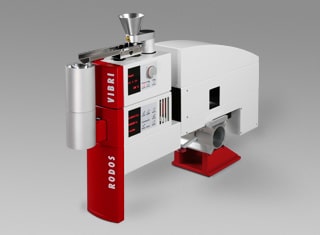
Dry dispersion is the go-to method for demanding applications of dry powders, granulates, fibres and other bulk solids, which are to be characterised in their original, dry state. Both fine, cohesive particles and coarser, metastable particles from under 0.1 µm to 4,000 µm are accelerated using powerful and easily dosable compressed air dispersion, and reliably and reproducibly dispersed in RODOS free jet. Gentle gravitational dispersion in the GRADIS freefall shaft, which combines acceleration in the gravitational field with deflector plate cascade, is available for slightly fluid, coarsely dispersed particles from 10 µm to 10,000 µm. FIBROS dispersion is used for the fast and reliable characterisation of fibres ranging from 500 µm to 30,000 µm in length and 5 µm to 5,000 µm in diameter. The combination of a carding unit, brush, sieve and jet nozzle quickly disperses even tangled fibre collectives, and feeds the separated fibres to the image analysis sensor in the airflow.

Disperser for dry powders, granules, fibres

RODOS dry dispersion, with compressed air and particle accelerations of up to 100 m/s, achieves unique dispersion performance for powder, fibres and granulates, ranging from under 0.1 µm to 4,000 µm. Sample quantities of under 1 mg to 1,500 g are reliably and reproducibly dispersed. Statistically significant analyses are achievable with sample volumes of up to 1,000 ml, even with widely distributed particle systems. The accelerated individual particles are supplied to the HELOS laser diffraction or QICPIC image analysis measurement zone in the aerosol open jet, and precisely measured.

Disperser for fibres and granules

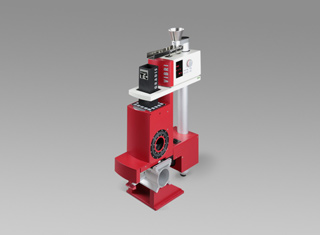
The GRADIS freefall shaft with deflector plate cascade is the go-to choice for dispersing free-flowing powders, fibres and granulate from 10 µm to 10,000 µm. Gentle dispersion – including of larger sample quantities up to 1,000 g – is ideal for coarser or metastable particles that are to be supplied to laser diffraction with HELOS, or image analysis with QICPIC.

disperser for fibre characterisation

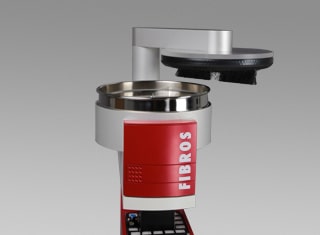
FIBROS offers gentle separation and dosing of dry fibre collectives – even those that are heavily entangled. The fibre disperser is adapted to applications with fibres ranging from 500 µm to 30,000 µm in length and 5 µm to 5,000 µm in diameter through the use of different brushes, carding units, and sieves, and is available for fibre characterisation with the QICPIC image analysis sensor.